
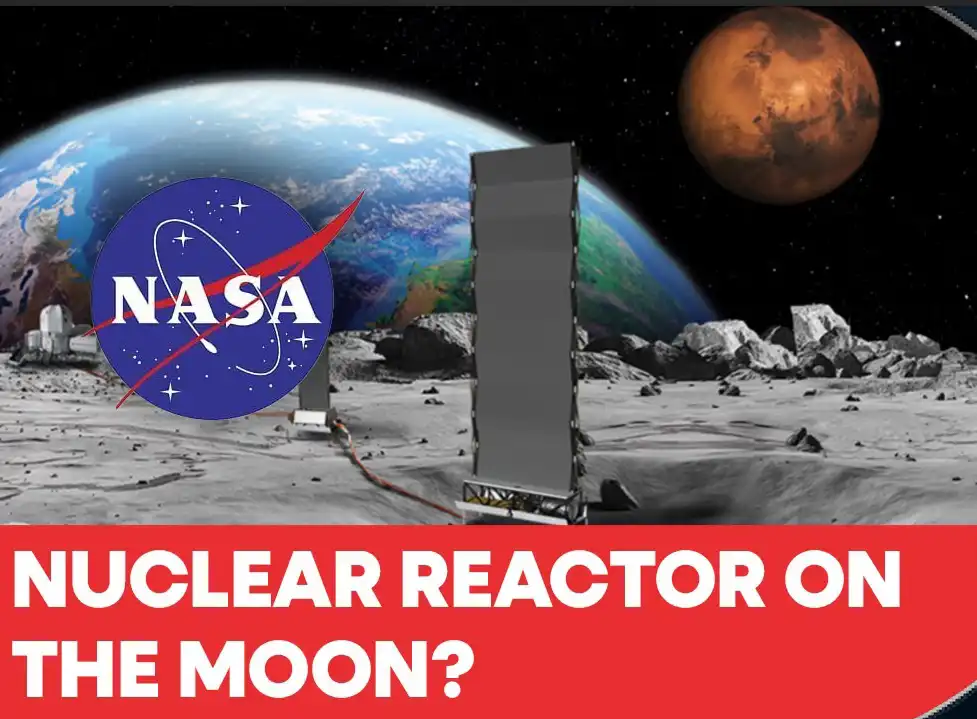
his week NASA administrator Sean Duffy declared the Trump Administration’s intention to land a working nuclear fission reactor on the moon by the end of the decade. “We’re in a race to the moon, in a race with China to the moon,” Duffy said.

Planting reactors is more effective than planting a flag in the lunar dust. Duffy referenced the idea of a “keep-out zone” around a reactor that effectively lays claim to a desirable area, like a craters holding frozen water.
Does Duffy’s 5-year timetable seem too aggressive? Not particularly, when you consider that NASA and its many contractors have been relying on atomic power for a long time. Since the 1960s, NASA has powered Apollo missions, space probes and Martian landers using radioisotopic batteries that turn the heat emitted by Plutonium-238 and other decaying isotopes into electricity. The Apollo devices are still on the moon with those on Voyager and Pioneer probes were the first manmade objects to leave the solar system.

But those devices only put out 100 watts or less. The nuclear fission reactors like what Duffy is talking about are far more complicated. They generate heat by splitting apart Uranium-d238, and would put out 100 kilowatts. That’s only enough electricity for a couple dozen homes on Earth. You’d need a lot of them to power a moonbase.
Do we need nuclear on the moon? A decade ago, NASA decided the answer was yes. Nighttime lasts for 14 Earth days in many lunar locations, making solar panels unreliable. And you can’t burn oil, coal or gas in a vacuum even if you could get it into orbit.
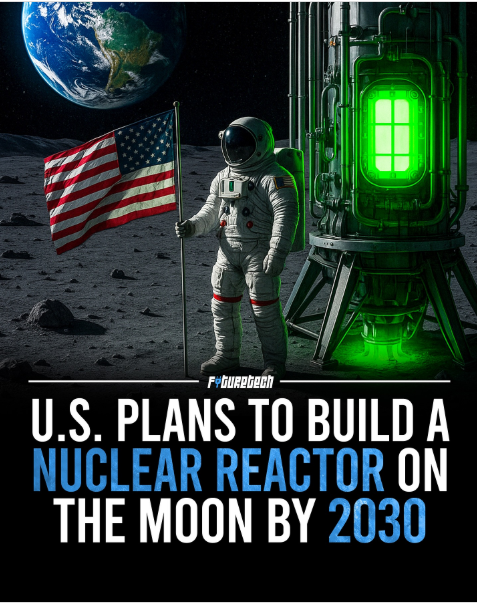
NASA first validated microreactor tech via something called the Kilopower project, then in 2022 gave $5 million grants to three consortia to perfect 40 kilowatt designs. The specifications of the Fission Surface Power Project called for a system that weighs just 6 tons, can fit into a cylinder 13 feet in diameter and 20 feet long, and can work for 10 years, self-regulated, with no maintenance or refuelling required.
It’s a tough remit, says Sebatian Corbisiero, the national technical director for space reactors at the Idaho National Lab, whose team selected the companies for the year-long NASA study. “On Earth reactors are not designed to be low mass and small. In space you need as little mass as possible, to fit on a rocket,” he says.
Corbisiero does believe a lunar reactor is an important and necessary first step to developing systems that could sustain a Martian colony. As his research group found in 2023, “Surface nuclear power is required for a sustainable lunar presence.”