
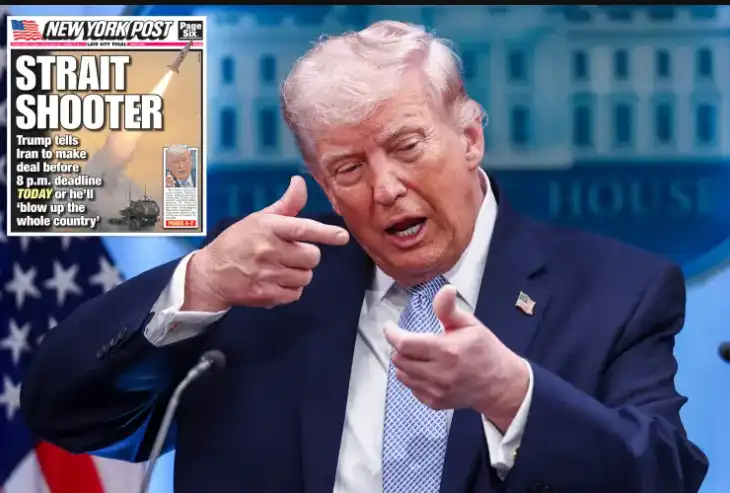
Iran agreed Tuesday to reopen the Strait of Hormuz as Tehran and the US reached a two-week ceasefire deal — a dramatic breakthrough in a nearly 40-day war that rattled global shipping and sent gas prices soaring.
President Trump announced the pause on military strikes on Iran less than 90 minutes before his 8 p.m. deadline — saying it was subject to Tehran agreeing to let ships pass through the key waterway. Israel also agreed to the two-week ceasefire, a White House official told The Post.

In a statement on Truth Social, Trump said he spoke with Pakistan’s Prime Minister Shehbaz Sharif and Field Marshal Asim Munir, who urged him to hold off on what he described as a “destructive force” set to be unleashed on Iran.
The cease-fire is “subject to the Islamic Republic of Iran agreeing to the COMPLETE, IMMEDIATE, and SAFE OPENING of the Strait of Hormuz,” he added.
“This will be a double sided CEASEFIRE! The reason for doing so is that we have already met and exceeded all Military objectives, and are very far along with a definitive Agreement concerning Longterm PEACE with Iran, and PEACE in the Middle East,” Trump said.

“We received a 10 point proposal from Iran, and believe it is a workable basis on which to negotiate.”
The president further explained that “almost all of the various points of past contention have been agreed to between the United States and Iran.”
“A two-week period will allow the agreement to be finalized,” he added.
“A two week period will allow the Agreement to be finalized and consummated,” he added. “On behalf of the United States of America, as President, and also representing the Countries of the Middle East, it is an Honor to have this Longterm problem close to resolution. Thank you for your attention to this matter.”
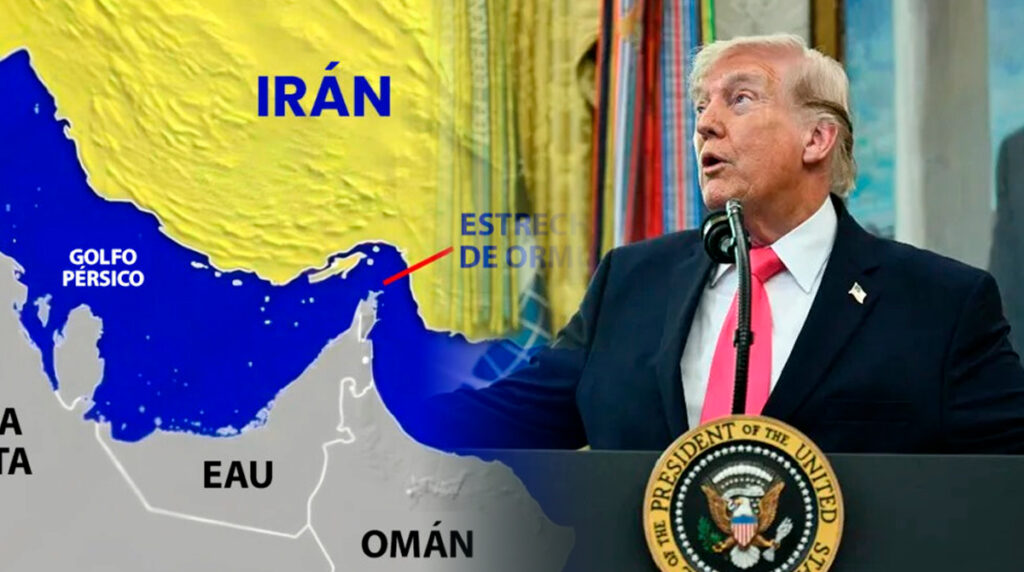
Tehran will allow passage through the Strait of Hormuz for the next two weeks under Iranian military management, Iran’s foreign minister Seyed Abbas Araghchi said in a statement.
That condition was key to Trump’s two-week cease-fire.
Araghchi also said if attacks against Iran are halted, then Tehran will “cease their defensive operations.”
The global cost of oil plummeted upon the news. The price of Brent crude, the international benchmark, nosedived 14% within an hour of Trump’s announcement.
Iran’s Supreme National Security Council confirmed the cease-fire agreement, noting it does not amount to full-fledged peace.
“It is emphasized that this does not signify the termination of the war,” the statement said, according to the Associated Press. “Our hands remain upon the trigger, and should the slightest error be committed by the enemy, it shall be met with full force.”
Iranian state-run media painted the announcement as proof that Iran forced Trump into an agreement.
“US President Donald Trump has once again retreated from his own threats, stating, I agree to halt bombings and attacks against Iran for a period of two weeks, and this will be a mutual ceasefire,” Iran’s IRNA News Agency posted to X.
The US and Iran are weighing in-person talks to finalize a peace deal, but the administration warns that nothing is final.
Latest strikes on Iran by US forces and Iranian retaliation
Today’s latest strikes targeted Kharg Island ahead of the April 7, 2026 , 8.P.M deadline as Trump threatened ‘whole civilization will die tonight’
(Zoom in and rollover/click icon for more information)
“There are discussions about face-to-face meetings between the United States and Iran, but nothing is final until it is announced by the President or the White House,” press secretary Karoline Leavitt said in a statement.
Iran wants two major concessions from the United States as part of its 10-point plan, including the removal of sanctions dating back to the George W. Bush administration and greater control over the Strait of Hormuz.
Tehran is also seeking guarantees that the US and Israel won’t attack again, along with the ability to charge tolls on cargo ships passing through the strait, a critical route for global oil shipments.
Nour News, an Iranian outlet linked to the country’s security council, listed additional demands unlikely to be accepted — including continued uranium enrichment, war reparations and the withdrawal of US troops from the region.
Trump has said repeatedly that his top goal for the war is to stop Iran from ever having a nuclear weapon.
A White House official refused to detail what was in the 10-point plan, telling The Post: “We do not negotiate in the press. As President Trump said, the 10-point document is a workable starting point.”
Another Trump administration official told The Post that there was “relief” among the president’s team, but that “nobody knows for sure” if the war is truly over.
“One thing that had become clear over the last 72 hours is that Iran was not as beaten down as Trump had been led to believe by the Defense Department,” the official said.

“I think the shoot-down [of the F-15 jet last week] was a sober reminder that Iran was still a very dangerous adversary [and that] while they had been degraded, they were nowhere near defeated. And that continuing the war would have likely led to the loss of more life, for little gain.”
The official said US objectives were largely met, including degrading Iran’s military capabilities, though its nuclear material is believed to remain deeply buried.
Israel, which joined the US offensive on Feb. 28, has not achieved its goal of fundamental regime change and may need pressure from Washington to maintain the cease-fire, the official added.
The official said that Trump and Iranian leaders can both spin the breakthrough as a win.
“Both sides can claim a win on this: The Iranians can say they demonstrated the ability to effectively close the Strait of Hormuz,” he said. “We can say that the Strait of Hormuz, if the Iranians don’t decide to keep attacking ships, is open.”
The conflict came at a steep cost, including 13 US troops killed, hundreds wounded and a price tag expected to exceed $100 billion.